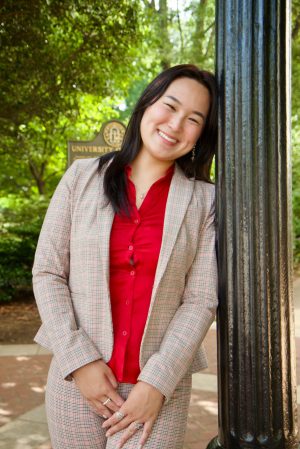
Thaomy Pham
Co-President
Current Location: Athens, GA
Current Status: Undergraduate - Senior
Affiliated School: University of Georgia
Experience
UVSASE
-FPC Director (2025)
-FPC Associate (2024)
UGA VSA
-NIS 22 Executive Director
-Internal Vice President (2024-2025)
-NIS 20 Sponsorship Director
Biography
Hey y’all! My name is Thaomy Pham, and I am a graduating senior studying Risk Management and Insurance at the University of Georgia. I grew up in a Vietnamese-American household where food, culture, and community were always a big part of my life. My favorite condiment is ketchup, and when I was little my dad used to call me THE ketchup monster because I would put it on almost everything. Even now, I still love trying new foods and experimenting in the kitchen.
One thing I’ve really enjoyed recently is cooking Asian fusion dishes, especially while studying abroad here in Italy. Being away from home has made me appreciate Vietnamese food and culture even more, and cooking has become a way for me to stay connected to it. Sometimes I’ll try to recreate dishes that remind me of home while also incorporating ingredients I find here.
Outside of school, I love staying active and trying new hobbies. Lately I’ve been getting into hiking, ceramics, and running, which have been fun ways to relax and explore new places. I also enjoy dancing for my local Vietnamese community and at my Buddhist temple, which has always been one of my favorite ways to stay connected to my culture and give back to the community that raised me.
Personal Statement
Growing up in a Vietnamese-American household, I was always surrounded by the importance of community. From volunteering at Moon Festivals to performing dances for Tết celebrations, I learned early on that preserving and celebrating our culture requires the dedication of people who care deeply about the community around them. These experiences shaped my pride in my Vietnamese-American identity and inspired my continued involvement in cultural organizations.
When I came to college, I was incredibly fortunate to find that same sense of belonging within the Vietnamese Student Association at the University of Georgia. Through my time in VSA, I have served as NIS 20 Sponsorship Director, the 2024–2025 Internal Vice President, and most recently as the Executive Director of NIS 22. These roles allowed me to grow as a leader while supporting initiatives that strengthen cultural identity, community engagement, and student connection.
Beyond my home organization, UVSASE has allowed me to see the strength of the Vietnamese-American community on a regional scale. After attending three SELCs and serving on the Family Programming Committee as both an Associate for SELC 24 and Director for SELC 25, I have had the opportunity to work with passionate leaders across the Southeast who share the same commitment to community.
As I approach graduation, I hope to continue serving this community by running for Co-President of UVSASE alongside Kenny Vu. My goal is to strengthen the structure and collaboration within the Executive Board and Cabinet while creating more opportunities for connection beyond SELC and Olympics. I also hope to deepen the Southeast region’s relationship with UNAVSA so that our community can continue to grow alongside Vietnamese-American organizations across the country.
UVSASE has given me a community that has shaped my college experience, and I am committed to helping ensure that future students can experience the same sense of belonging, leadership, and pride in their identity.
UVSASE
-FPC Director (2025)-FPC Associate (2024)
UGA VSA
-NIS 22 Executive Director
-Internal Vice President (2024-2025)
-NIS 20 Sponsorship Director
One thing I’ve really enjoyed recently is cooking Asian fusion dishes, especially while studying abroad here in Italy. Being away from home has made me appreciate Vietnamese food and culture even more, and cooking has become a way for me to stay connected to it. Sometimes I’ll try to recreate dishes that remind me of home while also incorporating ingredients I find here.
Outside of school, I love staying active and trying new hobbies. Lately I’ve been getting into hiking, ceramics, and running, which have been fun ways to relax and explore new places. I also enjoy dancing for my local Vietnamese community and at my Buddhist temple, which has always been one of my favorite ways to stay connected to my culture and give back to the community that raised me.
When I came to college, I was incredibly fortunate to find that same sense of belonging within the Vietnamese Student Association at the University of Georgia. Through my time in VSA, I have served as NIS 20 Sponsorship Director, the 2024–2025 Internal Vice President, and most recently as the Executive Director of NIS 22. These roles allowed me to grow as a leader while supporting initiatives that strengthen cultural identity, community engagement, and student connection.
Beyond my home organization, UVSASE has allowed me to see the strength of the Vietnamese-American community on a regional scale. After attending three SELCs and serving on the Family Programming Committee as both an Associate for SELC 24 and Director for SELC 25, I have had the opportunity to work with passionate leaders across the Southeast who share the same commitment to community.
As I approach graduation, I hope to continue serving this community by running for Co-President of UVSASE alongside Kenny Vu. My goal is to strengthen the structure and collaboration within the Executive Board and Cabinet while creating more opportunities for connection beyond SELC and Olympics. I also hope to deepen the Southeast region’s relationship with UNAVSA so that our community can continue to grow alongside Vietnamese-American organizations across the country. UVSASE has given me a community that has shaped my college experience, and I am committed to helping ensure that future students can experience the same sense of belonging, leadership, and pride in their identity.
Application Questions & Responses
My biggest motivation for running for E-Board is the community that UVSASE has given me over the past few years. Through attending SELC, working on Family Programming, and connecting with people across the Southeast, I have been able to see how strong and meaningful this community can be. It is a space where Vietnamese-American students from different schools can come together, support each other, and celebrate our shared identity. Because of the experiences and friendships I have gained through UVSASE, I feel a strong responsibility to give back to the community that has given me so much.
Running for E-Board is my way of continuing that work by helping create more opportunities for people to connect, grow, and feel like they belong within this organization. I want to help strengthen the relationships between schools, encourage more involvement across the region, and continue building a community that future students can benefit from just like I did.
I believe my experiences both within VSA at UGA and within UVSASE have prepared me well for this role. Within my home organization, I have served in several leadership positions including NIS 20 Sponsorship Director, 2024–2025 Internal Vice President, and NIS 22 Executive Director.
Through being NIS 20 Sponsorship Director, I have raised $30k for UGA VSA, which is the greatest amount to be raised in NIS’s 20 year history. I am very organized and well-thought out in terms of budgeting, outreach, and developing relationships with our sponsors as many of them have continued to return throughout my years of undergraduate at UGA. As Internal Vice President, I proved myself capable of developing strong friendships and connections with our UGA VSA members, staff, and leadership as I was responsible for not only creating events and planning our Anh Chi Em Program, but also being the bridge between our members and E-Board. Finally, as Executive Director of NIS 22, I oversaw the very show that sprouted my love for UGA VSA as a senior and continued to support our leadership through various ways as well as working alongside Kenny Vu, the president of UGA VSA, to ensure that our long-standing cultural night continues to make an impact on the Vietnamese-American identity and community in Georgia.
In addition to my experience at UGA, I have also been actively involved within UVSASE. I have attended three SELCs and served on the Family Programming Committee as both an Associate for SELC 24 and Director for SELC 25. My organizational and advanced planning skills have allowed me to work well with members of the Southeast community, understand how programming operates, and see firsthand the impact UVSASE has on its members. Because of these experiences, I feel confident in my ability to contribute to the organization at a larger level. I understand both the needs of individual VSAs and the broader goals of UVSASE, and I hope to use that perspective to help strengthen connections within the region and continue building opportunities for our community.
Interview Questions & Responses
I would like to say my principal weakness is definitely biting a lot more than I can chew or just taking on a lot more than I can handle per se. And it’s something I’ve kind of just worked through at the moment with just scheduling and and just reaching out. How it’s gonna interfere later on is there are 19 schools within the region, hoping to gain more on and working with scheduling interviews with all the Presidents as well as projects, I would like to get it done in the position. It might determine or it will interfere because I will have a lot more on my plate, working with a lot more individuals and then also working with the events that UVSASE does commit or does put on. How might I overcome them is basically just making sure that I’m scheduling everything accordingly ahead of time. And then as well as being comfortable with asking for help asking other fellow Eboard members to see if they can help take some of the slack or if I’m short during some areas, just so they are transparent on where I’m at and I can more efficient get what I need to do, done in time or in a timely manner as well as just working with the president as well as see if they can work with me and try to get some of the projects done as well. So just overall transparency and being able to reach out.
Okay, so a situation where someone work was criticized, was definitely planning as Hospitality Director, I’m trying to get what I needed to do or done with them, I just wasn’t as clear or as organized as I should have been. And my team, my committee members, approached me about it, talk to me about it. How I handled it, I took it personally, not like, personally, not because of them, but more so on me that I should have done better, I could be doing better, especially in my position. And in that I internalized that feeling and then I did my best to overcome or basically solve any of the problems that I had originally or any problems they had with me and then making sure to ask them afterwards if there’s any way for me to do better oranything they want to see more out of me from, which falls into how I prefer my current feedback or criticism. I definitely don’t mind that all constructive criticism. If I’m doing wrong, I would definitely like to know that I’m doing wrong or if I’d need to improve, I would definitely like to know that I need to improve just so I can fix it. Because it’s one of those things where I feel like, if I don’t know, how will I fix it? Because even even if I’m paying attention to myself, there’s ways that I mean, everyone’s human and I will slip up. But if someone has any issues, I really hope people will just tell me right off the bat, because I’m pretty, I would say, in the moment, not in the moment, I’m a face to face person, I should say. I’m an open book. If you tell me this is a problem, and I will deal with the problem.
So the current pillars would be unity, leadership, culture, and development and advancement. Our strongest pillar would definitely have to be the leadership aspect.The reason why I say leadership is, say Element, or Olympics, or camp really emphasizes growing your leadership skills and then leading a team leading events and turns hoping to have more staff members or more committee members anything growing in that position. And then our weakest, I definitely would say, culture. In our events we do include a lot of cultural aspects. But I don’t see us applying culture as much to our programs, teaching more about the history, teaching more about, I guess, a sense of Vietnamese American but more. And then…yeah, not teaching as much sense of what it means to Vietnamese American or Vietnamese or everything that goes along with that saying like, what a normal everyday Vietnamese person does, their their beliefs, or kind of just their day to day lives or anything like that. How would I improve that pillar is to work on adding more segments or even just topics or discussions, where we can talk about what it means or have a discussion even about identity of what it means to be a Vietnamese American or Asian American to really talk about these things. And it’s something I definitely want to push more just because I myself, have been having an identity crisis trying to figure out like, what it means to be Vietnamese American, and if so, what does Vietnamese American mean to my role in society? What should I be doing? And so discussion questions, bring up topics to talk about even more I guess segments that camp or conference. I don’t know how we do this for Olympics, probably not that maybe toss him more like cultural games during conference as well, instead of just some of the more popular games or popular American sports or so. And then really talking about like the history of immigrants and moving to the US as well, because I feel as that’s a very important as we get further generations and generations further away from first generation Asian Americans or even from our parents, which were immigrants, we tend to lose the, I guess, severity or the impact of how much our past ancestors or like family had to really push to give us the life that we had here. So those are the topics I really want discussed in all of our programs and off to the side as well.
With everything that’s going on, traveling is definitely gonna be restricted, it’s gonna definitely be a little bit harder for us to meet. And this is why the online platform is something that we definitely need to research more and move into. Say any virtual experiences and even going back to what I said before, opening up topics or discussions where anyone in SE can meet and freely talk and discuss about their experiences and even share, say like, have one night where everyone kind of discusses and talks about their families experienced going to the US and really sharing that so that we’re constantly talking about issues that need to be talked about and then building the community. And then even with the, say, games, we can do online game nights to bring the communities together, we can even split, say, like the region into spatial areas like have almost like a tournament even to have one region or a couple schools on one side and keep them in groups and then constantly just switch up groups. So each group is talking with new people every time because sometimes even with larger groups, people are a little bit more scared or shy to talk to you. So we can open up multiple, I guess chat rooms to even have people discussing different topics as well. So moving towards an online platform, is I guess, in my beliefs the best way that we can address the travel issue in the travel ban because at this time, only thing we can do is really just work around with what we have.
With the director, I would personally reach out to them first, have a talk with them, get to know what’s going on…Well, actually, you can do this with both executive board members as well. Because everyone signs on to a role for it’s almost like they agree to the specific terms that they need to get this job done. So if there’s lacking or slacking in the position, there usually is an underlying reason of why they’re not making or making deadlines or not getting their work done. So first would be talking to them kind of get an understanding of why they’re not getting their work done. Is it like personal reasons? Are they not able to? I guess organize well or if they’re having any troubles, then seeing what ways can I help in what ways can another committee help? If we can take some of the load off, either the director or the executive board to see what helps gets results with them. And then if they’re constantly not doing their job well, are they constantly falling back, then it’s something that for a director, I would talk to other fellow executive members, seeing if they can reach out, see if they can make an impact, get through to them. If not working with the Exec Board, you’d have to come to a decision to see what the next plan of action would be if we personally cannot get them to work. And then it just comes down to a team decision. And then for an executive board member, it would be a similar process, we would talk to them, get down to them personally see what’s going on, and then see if there’s any way to alleviate some of that workload or help out or any personal matter that we can help out with and then if not, it’s something that we have to talk as a group together and see what needs to be done next.
Now, if two members on executive board were having some problems with each other, and it was leaking into the work environment, what I would do is sit down with each of them individually and listen to their side, to kind of get a better understanding of where each of them are coming from. And then seeing where their anger lies or any discretion or any aggression, and then see if I can talk to them if they can work out a solution or like a middle ground. And then from there, I will take those answers and then I’ll keep those to my heart when I have both of them sit down and then give each of them time to talk without the uninterrupted time to talk. So then the other person can kind of listen. And then I’ve worked as a mediator, try to find some middle ground where they can get a mutual understanding, to resolve the issue or at least, quell the issue. And then also to reiterate that I understand there is some personal problems, but there also is a deadline. And this is a professional position, and we need to keep professional and personal, separated. And then if for at least if the issue is not able to be resolved at the moment, because I don’t know what’s going on if their anger is just unquenchable at the moment, I would say hold that anger off to the side for this justice week until deadline is done so we can get work done and then give them specific tasks and goals to get done within that week. So then I can kind of check up on them and make sure they’re getting their tasks done. And then afterwards, if we can’t quell in the beginning, then we’ll see if we can after we get the work done, we have a little bit more time to kind of just work on the relationship between the two.
Now, if a member approaches me, claiming that they were sexually harassed, this is something I definitely want to talk to them about first to see if they’re comfortable talking about because that’s not something, it’s…sometimes it scars them…if they’re okay with talking about I would like to understand a little bit more of what’s going on. And then the other party that was involved. And then I would like to see if there was anyone else nearby or around that could also back up these statements and then talk to the other person as well to see their side because this situation is a very heavy topic to blame right off the bat and to charge right off the bat because there’s always some missing there’s always a potential for misinformation and I don’t want to ruin anyone’s lives for, by not clearly check into the situation. So I will talk to the person claiming or saying stating that they were sexually harassed, the person who they claimed, sexually harassed them, and then check to see the situation if there was any way I could find evidence or proof or anything. If there’s any videos or anyone around that can I can listen to and then I would definitely like if it is comfortable with that member, if I can talk to the rest of Eboard about it to make a decision, because I feel like that decision is such a heavy decision that I cannot make a call on my own. So I feel more comfortable talking with the rest of Eboard to make sure like, what our next plan of action do we report the case or should we check more into if there’s any inconsistencies in like one or the other stories to see if we can find any common ground or not a common ground, anything that leads to facts.